We are proud to share that we have helped fund new engagement boards, equipped at every inpatient bedside across the Women’s and Children’s Health Network.

These boards were thoughtfully co-designed with clinicians, consumers and families. Their purpose is simple yet powerful: to support clearer, more meaningful conversations about each patient’s care and what matters most to them. The boards include dedicated spaces to write messages and questions for staff, note how the patient is feeling and share their daily goals.

Working alongside Aboriginal consumers and staff, a version has also been developed to create culturally safe, respectful and meaningful engagement for Aboriginal patients and families.

By empowering shared decision making, the engagement boards help patients and families feel informed, involved and confident in their care journey, while also acting as an important tool for clinicians to share patient information.
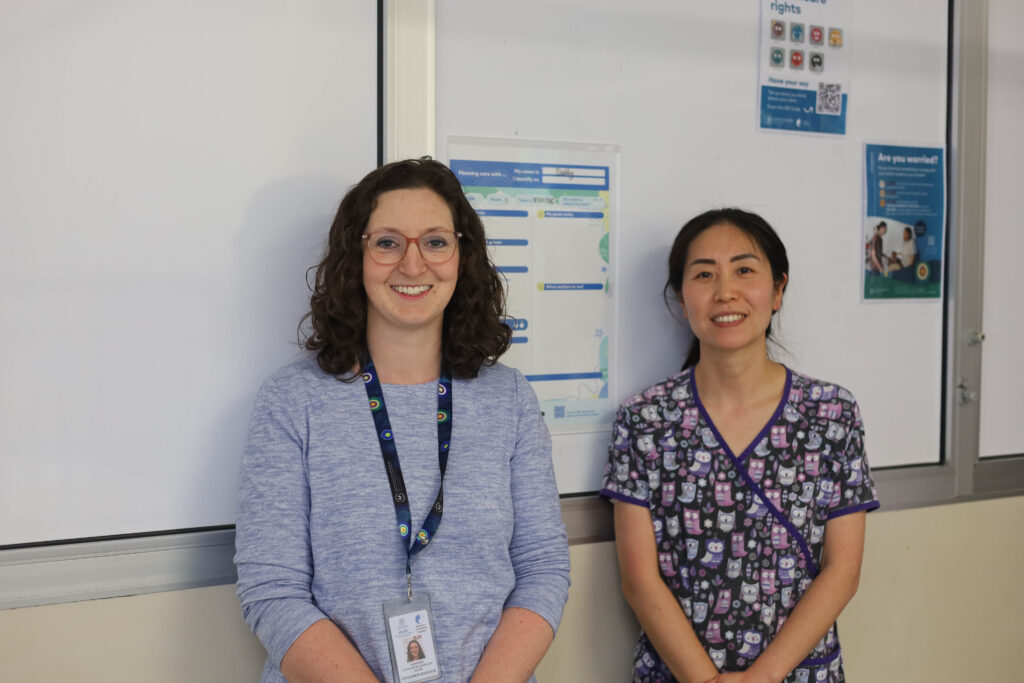
Consumer Advocate Hannah and Registered Nurse Sunny, who were involved in the project.

We’re incredibly grateful to everyone involved in bringing this initiative to life. These small moments of connection and communication can make a profound difference to the wellbeing and experience of families during their hospital stay and we are honoured to help make that impact possible.

We are so grateful for our ongoing partnership with BIG W, who work alongside us to support the health and wellbeing of our community. This year, there are wonderful opportunities for you to get involved and make a difference while you do your Christmas shopping.

When you visit your local BIG W this Christmas, you can help support families under the care of the Women’s and Children’s Health Network in two simple ways:

Charity Wrapping Paper
Purchase a roll of special-designed charity wrapping paper, featuring artwork by Hollee, a patient at the hospital. At just $5 a roll, it’s a wonderful way to make your gifts look extra special while giving back.

$2 Festive Tokens
As you head through the checkout, you can also purchase a $2 festive token. You can choose to take your token home to hang on your tree or add it to the special display in-store, contributing to a growing community collection.

When you purchase charity wrapping paper or festive tokens at South Australian BIG W stores, 100% of proceeds go directly to supporting the work of the WCH Foundation.

Thank you to BIG W and their incredible community for your continued generosity. Your support helps us enhance the patient care experience for countless children and their families.

Find my closest store

Helping infants feel safe, supported, and understood is one of the most powerful ways parents can nurture their child’s mental health and set the stage for positive social and emotional development.

Yet, for many new parents, the transition to parenthood is filled with the challenges of sleepless nights, soothing a crying baby, and building a strong parent–infant bond. Learning how to navigate these challenges before birth can make a world of difference, but few parents are given this opportunity.

To address this gap, Dr Alyssa Sawyer and her team at the University of Adelaide, SA Medical Imaging (SAMI), and the Women’s and Children’s Health Network (WCHN) developed an attachment-focused intervention. A pilot trial showed that parents facing social and emotional adversity improved their ability to bond with their baby, felt more confident as parents, and gained valuable knowledge about safe infant care. Importantly, parents who participated in the trial asked for one key change: to make this support available to all new parents, not just those at risk.

The WCH Foundation is proud to support the development of this program as a universal intervention, ensuring every family can benefit. The research team will work with parents and clinicians to adapt the program for delivery alongside routine care.

“What we’re hoping we’ll achieve is designing this intervention in a way that can support all parents who come through the hospital to have support for psychological and attachment relational health supported around their routine care across the antenatal and postnatal period.” – Dr Alyssa Sawyer

The program combines innovative approaches to support parents before and after birth, including attachment-focused ultrasounds at the 20-week scan to help parents connect with their baby, antenatal virtual home visits during pregnancy to help parents reflect on their baby’s experiences, and postnatal virtual home visits to provide guidance on bonding, managing crying and sleep, and supporting emotional development.

If successful, this project could strengthen parent–infant bonds, build parents’ confidence, promote infant mental health, and ensure universal access to early support, giving every baby the best possible start in life.

Find out more about the research we support, here.

Borderline Personality Disorder (BPD) is a serious mental health condition that makes managing emotions incredibly challenging. For mothers with BPD, who often carry their own histories of trauma, this can make it harder to respond to their baby’s needs and build the secure attachment every child relies on for healthy development.

When this bond is disrupted, children face a greater risk of developmental, emotional, and mental health challenges later in life. For mothers, the experience can be overwhelming, often leading to feelings of guilt and failure that make parenting even more difficult.

The Mother-Infant Dialectical Behaviour Therapy (MI-DBT) program, developed by the Women’s and Children’s Health Network (WCHN), is changing lives. This 24-session group program teaches emotional regulation and parenting skills to help mothers strengthen their bond with their babies. Mothers who participate often show incredible determination to give their child the best start in life, and the program has been highly successful in improving mother-infant relationships.

However, demand for MI-DBT far exceeds availability. Families face long waits for a place, and for those in rural or remote areas, the program is often out of reach entirely.

The WCH Foundation is proud to support A/Prof Anne Sved Williams and her team (Dr Rebecca Hill, pictured) in developing a telehealth version of MI-DBT, making it accessible to families no matter where they live.

“The benefit is in the relief of both their distress but also changing the trajectories for those kids so they might go on to have better futures and in turn, not repeat that intergenerational transmission.” – Dr Rebecca Hill

This innovative project will expand access to MI-DBT for mothers in rural and remote communities, reduce wait times for families eager to get help, and train more clinicians to ensure the program can grow and be delivered consistently nationwide. By breaking down barriers to care, this project has the potential to transform the lives of mothers and their children, building stronger, healthier families.

Find out more about the research we support, here.

Sign up for our latest news

"*" indicates required fields

This field is for validation purposes and should be left unchanged.

Name *

Name*

Email *

Email*